
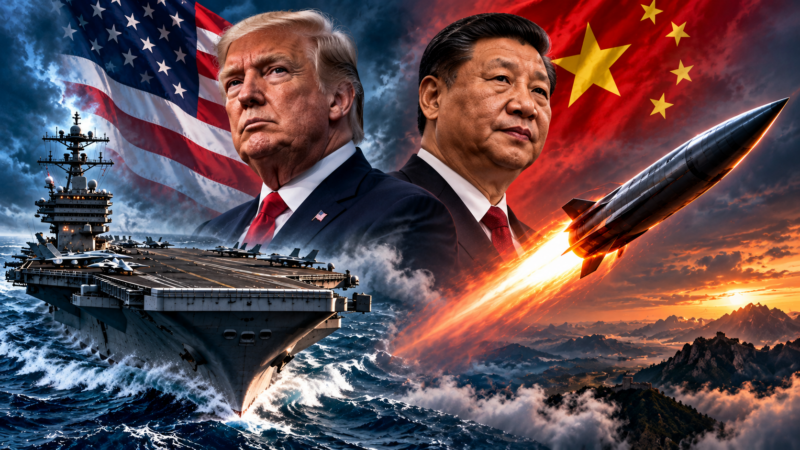
A meme built on a real number
Aircraft carrier vs hypersonic missile — this is the real question hiding behind a widely shared post that recently framed a dramatic standoff: the United States boasting about its $13 billion nuclear aircraft carrier as an unmatched projection of power, and a sharp reply pointing out that the same $13 billion could buy roughly a thousand hypersonic missiles — and it would only take one to sink it. Dressed up with angry photos of world leaders and a “ratioed” caption, it reads like pure internet theater. But strip away the theater, and there’s a genuinely serious military debate hiding underneath it — one worth understanding properly rather than dismissing as just another viral exaggeration.
The carrier figure checks out
The $13 billion price tag is accurate. It matches the cost of the USS Gerald R. Ford, the lead ship of the US Navy’s newest and most advanced carrier class — a 100,000-ton vessel carrying roughly seventy-five aircraft, widely regarded as the single most powerful conventional weapons platform ever built.
The missile math is closer to reality than it sounds
This is the part most people assume is pure exaggeration — and it isn’t. Defense analysts have estimated the cost of China’s DF-21D “carrier killer,” a purpose-built anti-ship ballistic missile capable of striking a moving carrier from land-based launchers over 1,500 kilometers away, at around $15 million per unit. Run that math against a $13 billion carrier, and you land close to 860 missiles — not far at all from the “1,000” figure used for effect. China has continued building on this capability with the DF-26B “Guam Killer” and the hypersonic DF-17, which travels at roughly Mach 10 and is designed specifically to defeat existing ship-based interception systems.
So the headline comparison, exaggerated as it may sound, is not fabricated from nothing. Respected US Naval Institute assessments have gone as far as concluding that a single well-placed DF-21D strike could disable a supercarrier, and that current US Navy defenses have no fully reliable way to intercept it.
Where the meme oversimplifies
What the post leaves out is doctrine, not arithmetic. A carrier never sails alone — it moves inside a strike group layered with destroyers, cruisers, submarines, airborne early warning, and missile-defense systems built for exactly this threat. Hitting a fast-moving, defended target with a maneuvering warhead traveling at hypersonic speed, reliably, in real combat conditions, remains one of the hardest problems in modern military engineering. China has proven the technology works in tests; whether it would work with the same precision against a carrier group actively defending itself is the actual unresolved question serious analysts are still debating — not whether the missiles exist, and not whether they’re cheap.
Why this is worth taking seriously anyway
The reason this comparison keeps resurfacing isn’t clickbait alone — it reflects a real and consequential shift in military thinking. Aircraft carriers were built for an era before precision-guided, low-cost, mass-producible missiles existed. China’s entire “anti-access/area-denial” strategy in the Pacific is built around exactly this asymmetry: force American power projection so far offshore that it becomes ineffective, without ever needing to win a direct naval battle. That is a strategic conversation genuinely worth understanding — it just deserves better framing than two shouting cartoon leaders and a fire emoji.
The bottom line
The numbers in this post are more grounded in real defense analysis than most viral content gets credit for. The theatrics, the invented dialogue, and the dramatic framing are pure entertainment — but the underlying question they’re built on, whether the aircraft carrier still makes strategic sense in an age of cheap precision missiles, is one of the most consequential debates in modern military strategy, and it deserves to be read about seriously, not just laughed at or shared for outrage.




Leave a Reply